Subscribe To This Site
|
Cultural Maturity ModelThe Case For Using a Culture Maturity Model
The case for using a cultural maturity model: I first became aware of the significance and importance of organisational culture in 1994 when I was involved in a business development exercise with a colleague and the significance of organisational culture - initially seen solely from a business development perspective - became firmly established on our radar. What we rapidly discovered was that company's that seemed very similar in size and line of business behaved very differently. We discovered that the business development/sales culture of the company was the differentiating factor. We realised that we had to adjust our sales messages accordingly.
But first we had to figure out the type of sales culture we were dealing with.
The development of the idea of a cultural maturity modelWe rapidly made 5 discoveries:
Cultural maturity model derived from a generic maturity model
"A maturity model is a structured representation of the stages of evolution of an organisation, as it transition through various developmental states and stages, in response to the impacts of changes in the organisation's operating environment. This evolution represents progress to more developed or advanced states of learning, insight, understanding and practise that support its strategic goals."
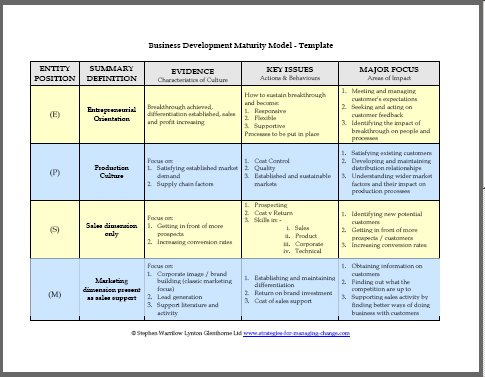
Business Development Maturity Template
With reference to our Business Development Maturity Model Template, you can see the structure of the template used to define an organisational culture, namely:
I am showing this early model because it is an excellent illustration of how the characteristics of an organisational culture are identified and summarised.
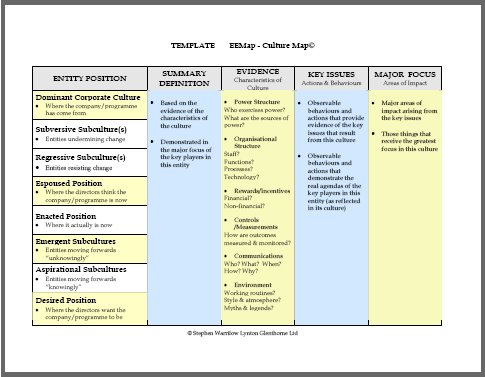
Organisational Culture Map
which forms the basis for the creation of a company specific cultural maturity model.
The stages of evolution of the organisation in transition through various developmental states can be mapped from any or all of present positions of the various subcultures within the organisation, plus the perceptual positions [i.e. where directors think it is and where it actually is] to the desired position of where the change leaders want it to be. The current positions and the path of progress of maturity of a company is totally subjective to that company.
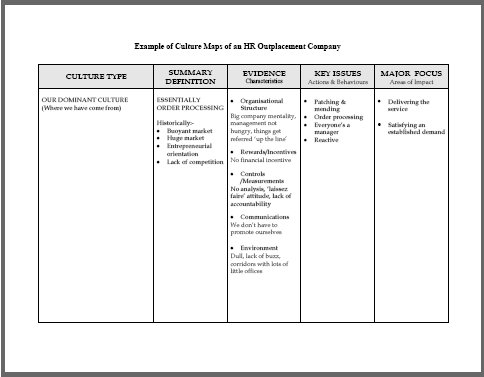
Here is an example of a summary of the mapping of an HR consultancy
This template has been used on many companies and in many, many different situations over the years - overtly [with client involvement] and covertly [i.e. I use it but don't involve my client as it may not be relevant or they may not be receptive.]
How to create a cultural maturity model
How to identify and unpack an organisational culture and sub-culture: With reference to the Template of an Organisational Culture Map shown in the link above: (1) Culture Type The dominant organisational culture can be unpacked in terms of
The distinctions between these different perspectives of the dominant culture are very important because they represent potentially significant gaps in perception that either are or will be the cause of issues in a step change scenario. Other factors here are the size of the company and the extent of change experienced within its relatively recent history - so the larger the company and / or the greater the amount of recent change - then there is a greater likelihood that these gaps in perception will be present. There can also be 2 different types of subculture - those that are:
In both cases, the people concerned may either be aware and conscious of how they are and what they are doing or unaware and unconscious. There may well be other types of sub culture present. The purpose of the template is to stimulate awareness of the possible existence of these entities within your organisation. A sub culture can exist within an entity as small as 2 or 3 people or a much larger group such as a whole department, or anything in between. It usually evolves around and is focused on a specific function such a sales or accounts and /or a strong personality or dominant individual. The importance of the sub culture is that reflects what the people within it really believe and their usually un-spoken attitudes and values - all of which are displayed in their behaviour and actions.
(2) Summary Definition This is based on the evidence of the characteristics of the organisational culture and demonstrated in the major focus of the key players in this entity. This definition is how you describe yourselves - the "look and feel" of how things really are e.g. a production or manufacturing culture, or a sales culture, or a typical family owned business.
(3) Evidence - The Characteristics of the Culture This can include things such as:
(4) Key Issues Actions and Behaviours
(5) Major Areas of Focus - Areas of Impact These can identified by:
Navigating through the issues to where you want to be
The best test to find out if you have done this exercise accurately - is to see how other members of your team [especially junior members] react. If it is accurate and authentic then the pictures and schematics that you create and the narrative and words that you document will be instantly recognisable and "ring true". Having established a cultural template of where your organisation is now, you can determine the template of how your organisation will look after your step change initiative and clearly see the gaps between these positions. This, in turn, enables you to determine a route that will navigate you through the issues that will arise - and especially to help you identify the full impacts of the changes on those people who will be most affected and to plan accordingly.
And in conclusion - the reason why using the concept of a cultural maturity model is so important is that the cultures of your organistion are the single biggest determinant of how people in your organisation will behave - and especially in the context of a step change - and thus determines the success or failure of your initiative.
The concept of Cultural Maturity was first presented by Dr Charles Johnston 30 years ago with the book Necessary Wisdom: Meeting the Challenge of a New Cultural Maturity.
Charles Johnston is a psychiatrist, author, and futurist. He is best known as the originator of Creative Systems Theory, a comprehensive framework for understanding purpose, change, and interrelationship in human systems.
Dr Johnston presents a societal view of cultural maturity with a distinct focus on the psychological, social, and leadership capacities that humanity will need to effectively address the questions that challenge us.
Merger Failures - value destruction and cultural conflicts - And how to avoid them!
Change Management Strategy - Key strategic leadership issues
Strategic Vision - and successful programme implementation
Pre-programme planning and review - the process
Return from "Cultural maturity model" to:
Project Management Maturity Model
|


 Here is the original