Benefits of change management
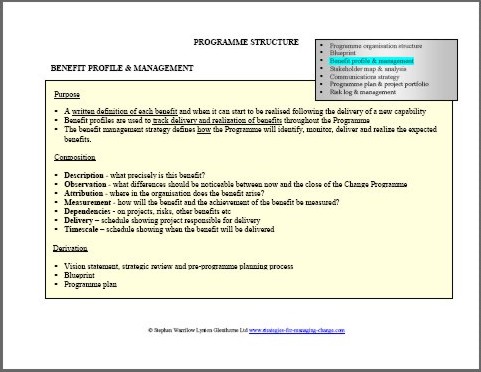
- the benefit management process is the activity of identifying, optimising and tracking the expected benefits of change to ensure that they are achieved.
Those benefits identified need to be defined so that the programme can monitor and track their progress. The definition is called the Benefit Profile.
These should be agreed with the managers of the business areas where they will actually be realised. They can then be managed and controlled by the Business Change Manager as this is of primary importance to the success of the programme.
The Benefit Profiles should detail:
The description
How it will be measured
Projected changes from the current business processes and operations
Inter-dependencies with other benefits
Key performance indicators in the business operations now and for the future, and current or baseline performance levels
Explicit linkages, wherever possible, between projects and deliverables
Dependencies on risks and other programmes or projects
Financial valuations
When it is expected to occur and over what period of time will realisation take place
The Benefit Management Strategy should include:
An overall benefit statement relating to the Programme’s Blueprint
The Benefit Profiles
How expectations will be managed through the ups and downs of running the programme and the realisation of the benefits of change management
Formal review points when an assessment of the benefits of change management that have been achieved will be carried out (Programme Benefit Reviews)
How changes to the Blueprint and business operations will be controlled as benefits are realised
Programme Benefit Management Reviews may be scheduled at any point during the programme as well as after the programme has completed.
The objectives of the Programme Benefit Reviews are to:
Inform those managing the programme of progress in the delivery and realisation of the benefits of change management, and to help identify any further potential for benefits
Assess the performance of the changed business operations against their original performance levels
Assess the level of benefits achieved against the planned Benefits Profiles
Review the effectiveness of the way benefits management is being handled, so that improved methods can be developed and lessons learned for the future.
The following questions may help structure a Programme Benefit Review:
Which planned benefits have been achieved? If they have been achieved, were the targets correct or should they have been increased?
Which planned benefits have not been achieved? Why were they not achieved? Can remedial action be taken to achieve them or has the opportunity been lost?
Is there a pattern to the success/failure that can be used to inform other realisation plans?
Were the assumptions on which the realisation of the benefits was based correct?
If not, what effect did this have on the realisation process?
Were there any unexpected benefits that have resulted? If so, can they now be planned and maximised further?
Were there any unexpected issues arising? If so, how can these be managed and minimised?
Are there any further potential benefits?
Do the measures applied appear to be the correct ones? Do they need changing or refining? Was the process of data collection to establish the measures effective?
The findings of each of the Programme Benefit Management Reviews should be communicated to the rest of the programme.
Change is a messy business...
Change is a messy business and it is fraught with complexity, and there are many things that can, and so often do, go wrong.
The projects to deliver new capabilities may have been delivered [on time and in budget] but without a strong focus on what is involved to realise or achieve the intended business benefits, then the initiative will still fail.
There are 3 over-arching themes which need to be addressed:
Leadership - that addresses the people side, and that pays particular attention to the personal impacts and transitions that accompany any significant organisational change.
A change model and methodology that is sufficiently holistic to encompass the comlexity and multi-dimensional nature of a major organisational change initiative.
Hands on practical action management that applies an equal focus to the people side as to the task side of execution and implementation.
 Subscribe To This Site