Subscribe To This Site
|
Process Theories Of MotivationPersonal Needs Drive Behaviour
Process theories of motivation are about a cognitive rational process and concentrate on the psychological and behavioural processes that motivate an individual. Put simply, this is all about how people's needs influence and drive their behaviour. People need to see what is in it for them and to sense that "fair play" is being exercised to all concerned. Clearly a basic understanding of this is foundational to the psychological underpinning of successful change management and the strategies for managing change that will deliver that. These process theories of motivation also totally support and underpin the findings and practical observations of Goleman, Katzenbach, Pearson, Axelrod and others referred to in Inspirational Motivation and the research and thought leadership highlighted in Leading Change. The two main process theories of motivation are: Expectancy Theory Equity Theory.
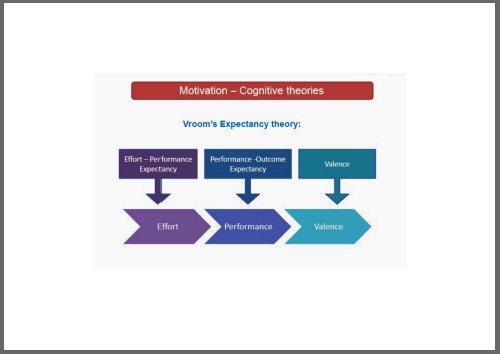
Process Theories of Motivation - Expectancy TheoryExpectancy Theory [also called Valence-Instrumentality-Expectancy Theory or VIE Theory] is associated with Vroom, Porter and Lawler and it suggests that effort (a) is linked to the desire for a particular outcome, and (b) moderated by an evaluation of the likelihood of success.
This is a pragmatic perspective that assumes that as we are constantly trying to predict potential future outcomes, we attempt to create what we perceive to be as realistic expectations about future events. Thus if things look reasonably likely and attractive, and if we know what to do in order to get there, and we believe we can actually do it, then this will motivate us to act to make this future come true. According to Victor Vroom, individual motivation depends on three variables, namely: Force, Valence and Expectancy.
Process Theories of Motivation - Adam's Equity TheoryAt a basic level, most people generally prefer to be in relationships where give and take are about equal. So if one person is getting too little from the relationship, then clearly they are going to be unhappy with this but it is also likely that the other person will also be feeling rather guilty about this imbalance. This is reinforced by strong social norms about fairness.
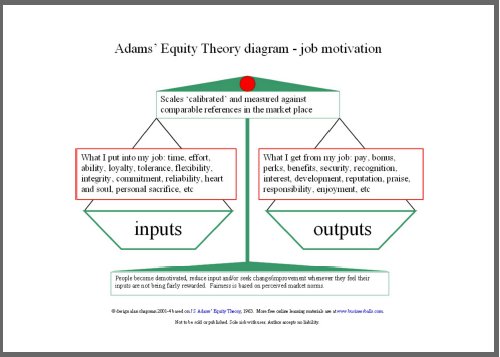
Equity theory states that in return for an input of skills, effort or production, the employee receives an outcome expressed in terms of any combination of salary, status and fringe benefits. This creates a ratio of input to outcome and equity is achieved when the ratios are the same for everyone in organisation. Equity theory looks at an individual’s perception of the fairness of an employment situation and finds that perceived inequalities can lead to changes in behaviour. When individuals believe that they have been treated unfairly in comparison with their coworkers, they will react in one of four ways: (1) Reduce their effort and productivity to better match the rewards they are receiving (2) Ask for more money or maybe take legal action (3) Change their own perception of the situation. (4) Resign and leave their job
So, in a nutshell, unequal treatment of staff leads to demotivation.
Practical Application of Process Theories of MotivationUnlike the other theories of motivation that we have discussed on this site, process theories of motivation are to do with motivation that is rational and cognitive rather than emotional. In simple practical terms, these theories show the change leader that you have to appeal to people's heads as well as their hearts. People need to have the WIFM [What's In It For Me] question answered. They need to see the steps and they need to believe that they can do it and that they want to.
They also need to believe in the equity or fairness of what you tell you.
Further Resources
Motivation Theories - Getting people to take action Maslow's hierarchy of needs - A paradigm shift ERG Theory - Practical application to leading change Herzberg Motivation Theory - Satisfied and motivated Acquired Needs Theory - Goal seeking achieversEmployee motivation techniques - How to achieve peak performance Myers Briggs Personality Types - Why so importantInspirational motivation - How to inspire your people in tough times
Return from Process Theories of Motivation - to Inspirational Motivation |