Subscribe To This Site
|
Maslow Theory of MotivationA Paradigm Shift
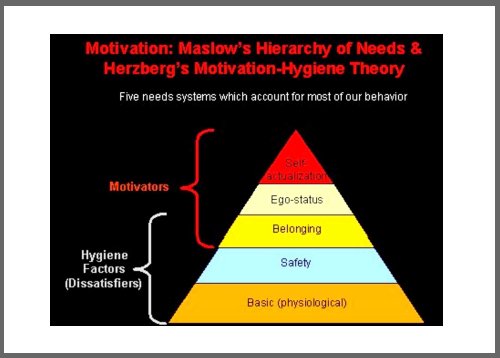
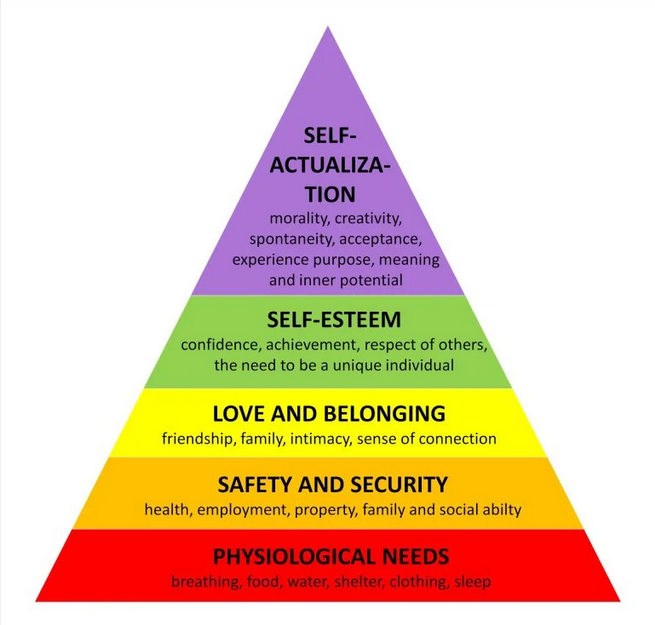
Are You Giving Your People "Peak Experiences"?The Maslow Theory of Motivation also known as "Maslow's Hierarchy of Needs" model was developed between 1943-1954, and first widely published in Motivation and Personality in 1954. The original model comprised five needs. However more levels were added in a later book: "Toward a Psychology of Being"[1968]. The original 5 level version remains the most widely known and is the one we will consider briefly. Starting from the premise that each human being is motivated by needs that are inborn, presumably as a result of tens of thousands of years of evolution, the Maslow theory of motivation suggests a hierarchy of needs:
A Paradigm Shift Towards Successful Change ManagementThe Maslow theory of motivation brought a new face to the study of human behaviour. Maslow was inspired by greatness in the minds of others, and his own special contribution to the field of motivational psychology led to the creation of the concept of Humanistic Psychology. Most psychologists prior to Maslow had focused on the mentally ill and the abnormal. In complete contrast the Maslow theory of motivation investigated and attempted to define positive mental health. In so doing, he instigated a paradigm shift via Humanistic Psychology – predicated on the belief that humans are not simply blindly reacting to situations, but trying to accomplish something greater. This new approach represented in the Maslow theory of motivation became the source of many new and different therapies, all grounded in the belief that people possess the inner resources for growth and healing and that the point of therapy is to help remove obstacles to individuals' achieving them. It also forms the basis of much current understanding of what constitutes good leadership and forms a major foundation of prevailing models and theories of successful change management.
Interesting, latest advances in neurology seem to be confirming the physiological "hard wiring" of the human brain to seek self transcendence as well as seeking survival.
The Special OnesThe views expressed in the Maslow theory of motivation, and other contributions to motivation theory from Maslow throughout his career stemmed:
So for example, Maslow used Einstein's writings and accomplishments to exemplify the characteristics of the self actualised person. What followed from these studies was the realisation that all of these “special” people had similar personality traits:
Another interesting common feature of these "special ones" is that they had regular and frequent "peak experiences"...
Peak ExperiencesBeyond the routine of needs fulfillment, the Maslow theory of motivation encompasses the idea of moments of extraordinary experience, that he defined in his 1964 book "Religions, Values, and Peak Experiences"as Peak Experiences. Peak experiences are described in the Maslow theory of motivation as especially joyous and exciting moments in life, involving sudden feelings of intense happiness and well-being, wonder and awe, and possibly also involving an awareness of transcendental unity or knowledge of higher truth. They usually come on suddenly and are often inspired by deep meditation, intense feelings of love, exposure to great art or music, or the overwhelming beauty of nature. Maslow described how the peak experience tends to be uplifting and ego-transcending; release creative energies; affirms the meaning and value of existence; give a sense of purpose to the individual; give a feeling of integration; leave a permanent mark on the individual, evidently changing them for the better. When peak experiences are especially powerful, the sense of self dissolves into an awareness of a greater unity. Were it not for our awareness of Maslow's strong and traditional Jewish background this could be the language of a zen master!
The Value Of Maslow's Theory of Motivation To Change ManagementThe most fundamental value of this theory is to emphasise and remind those of us involved in leading and managing change of the complexity and multi-facted nature of human needs and motivational drives. Closely aligned to that observation is the difficult realisation that people have transcendent needs and aspirations as well as the more prosaic needs of survival and "pay and rations".
The challenge here is to expand our understanding of what is involved in building the necessary win-wins with those upon we depend to deliver a successful change initiative.
Further Resources
Motivation Theories - getting people to take action ERG Theory - Practical application to leading change Herzberg Motivation Theory - Satisfied and motivated Acquired Needs Theory - Goal seeking achievers Process theories of motivation - Personal needs drive behaviour Employee motivation techniques - How to achieve peak performance Myers Briggs Personality Types - Why so importantInspirational motivation - How to inspire your people in tough times Return from Maslow Theory of Motivation to "Define Motivation"
|

 Here is an interesting comparison of