Subscribe To This Site
|
Programme PlanningThe pre-programme review and planning process(1) Introduction
The advantage of the smaller group is that you will move through the process more quickly, however the advantages of wider involvement are that: (1) you potentially achieve a greater level of early “buy in”; (2) you get a wider spectrum of inputs to the whole process; and (3) in so doing, this can form an integral early stage of the change process. The amount of time allocated to these programme planning processes is also another variable. Broadly speaking, the size of the proposed change and how business critical it is, are useful guidelines. [In my experience, working with a small team usually takes 1 to 3 days over a lapsed timeframe of 1 – 2 weeks and works best if done in stages with time for reflection in between sessions.]
But whatever time is allocated, it is time very well spent as the process is designed to: (1) make you think deeply about your proposed change; (2) to understand as fully as possible the impact it is likely to have, and (3) to work out clearly exactly how you are going to reap the benefits from the change.
Overview of the process
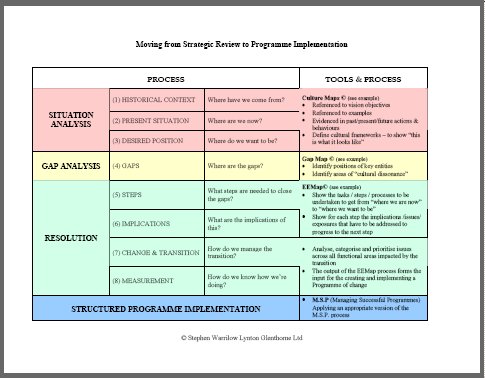
Here is a brief document that introduces the key stages of the EEMap process that we will be using. I recommend that you find a spare room and cover 2 walls with flip chart paper. What we are going to do on the first wall is write up and draw schematically the fullest description of what your organisation looks like now, and on the second wall, what it will look like after the change. In addition to the obvious stuff such as organisation structure and core processes etc we are going to pay particular attention to the cultural aspects of your organisation.
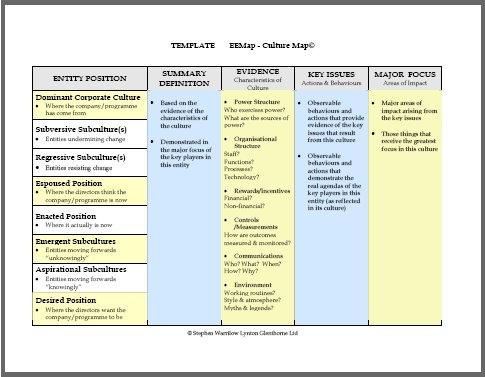
(3) Cultural maps - identifying and describing the different cultural entities within your organisation
As an key part of your programme planning I recommend that you look carefully at all of the different culture and sub-culture types, and see how many of these you can identify in your organisation. I also recommend that you work through all of the questions shown, and apply them to each (sub) cultural group identified. There is no right or wrong way of doing this, and how you choose to write it up is up to you [e.g. you can follow the format of the Culture Map Template and create your own templates, or write it up on the wall.]
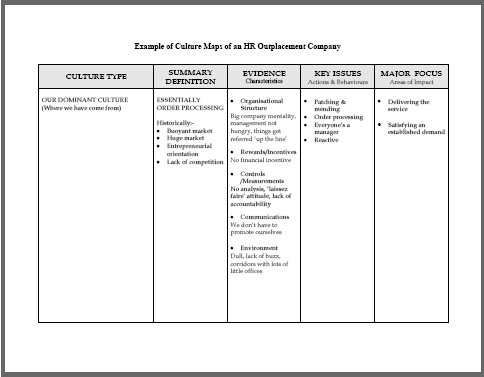
Example Culture Map and Gap Map
that was created for a HR company.
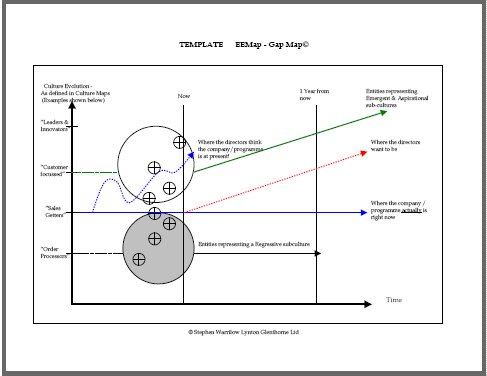
(4) Gap Maps - articulating, visualising and discussing the reality of the gaps within their organisation
As with the Culture Map there is no prescriptive way of representing this graphically - I use the style shown. It also helps to use the vertical axis as the line of cultural progression and the horizontal line as the time line. The whole purpose at this stage of programme planning is to create a simple pictorial representation of the different positions and the gaps between them. This is not a hard science but simply a vehicle by which directors and staff can articulate, visualise and discuss the reality of the gaps within their organisation and to do so in a unemotional and non-confrontational manner.
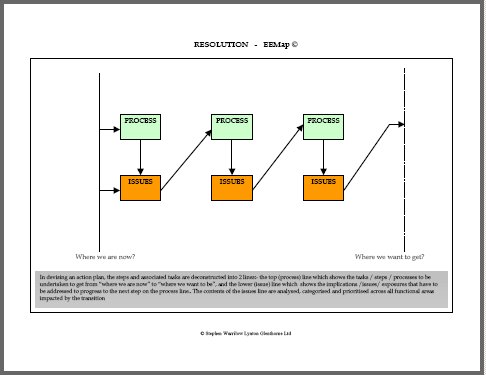
(5) EEMaps - identifying the issues, impacts and exposures that are going to emerge
What we are looking at initially, is: (1) what these gaps and differences actually are, then (2) looking closely at and documenting the obvious steps - tasks - core processes that we are going to have to undertake to get from the present to the desired position.
The diagram shows the core process / task steps to be undertaken - and all of the implications, issues and impacts associated with each step. The underlying assumption here is that we cannot successfully progress from "Step A" to "Step B" without having identified and successfully dealt with the associated issues. All issues identified and associated with each programme planning step are now analysed, categorised and prioritised across all functional areas impacted by the transition.
But these steps are so simple and obvious that they are usually over looked - and the result is a 70% failure rate.
Create a programme
Home Page
Return to top
|

 Here is the overview of