Subscribe To This Site
|
Stakeholder analysis and mappingIdentifying everyone who will be impacted by your change programme
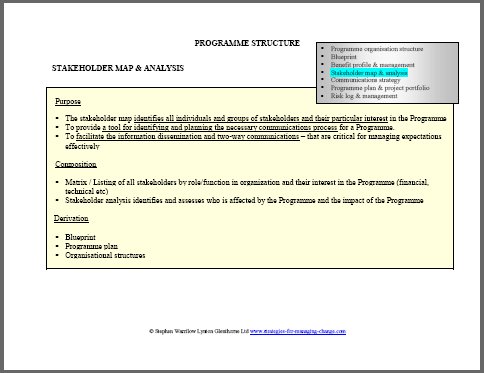
A Stakeholder analysis and map
is a useful way to capture and manage information about a large number of stakeholders.
For a change initiative to have a good chance of success a change model should be employed that captures and focuses on the multiple factors that need to be addressed.
What is required is, in effect, a multi-dimensional focus and a Programme Management based approach can provide that. One important aspect of programme management is “Stakeholder Analysis and Mapping” and this is all about, in other words: "Who is this step change going to affect and how are they going to react?". How well you listen to and respond to ALL of your stakeholders' issues - and are seen to be doing so - is a significant measure of the effectiveness of your management of these relationships.
3 Key QuestionsHere are 3 key questions to ask in how to manage expectations in a change initiative: 1. Do people really know what is expected of them? Do your people know how to translate the high level vision and strategy into actionable steps? People process things differently and they have different motivations. Most people are not able to translate a high-level vision or big-picture view into actionable steps. This does not reflect their commitment nor their capacity to execute it, what it means is that people need to be told what to do. 2. Do employees actually know what they can expect from you? It is also important that they know that you will work with them in "grinding out" in practical, manageable detail what the high level strategy, vision, values things actually mean for them as the "troops" in action. 3. Do your employees really know what is expected of each other? They also need to know what these actionable steps mean for them in terms of what they can and should expect from each other. The programme management based approach addresses the question: "Who is this step change going to affect and how are they going to react?" .
The Scope Of The Stakeholder AnalysisThe Programme will inevitably affect the working lives of many individuals and groups. Each of these should be identified via stakeholder analysis, together with their particular interest in Programme and mapped. The work undertaken at the Pre Programme Review and Planning stage will have identified many of these people and entities and the issues that will arise. They may be identified from the following:
Each of these people and groups will have a specific interest area, such as financial, technical, regulatory etc so when you are identifying them it is important to recognise their specific interest areas in order to ensure that their expectations can be managed effectively. There clearly will be individuals or groups who will be worse off as a result of the programme and who are therefore potential 'blockers' to the progress of the programme. Both the positive and negative viewpoints should be considered as part of stakeholder management. Also, the Pre Programme Review and Planning will have identified issues associated with these individuals or groups and determined potential solutions and strategies for resolving the issues.
Information dissemination and two-way communications are critical for managing expectations effectively.
Communication Strategy Go back to - How to do it!
|